
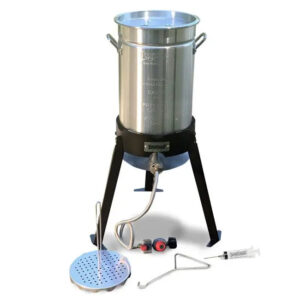
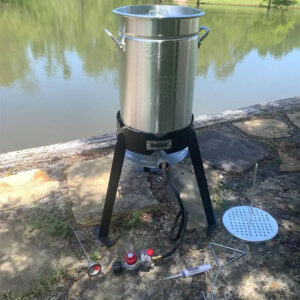
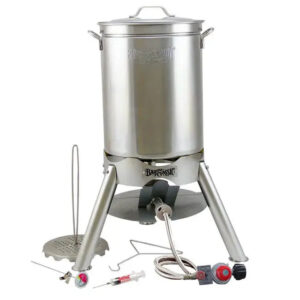
Bayou Classic 44qt Stainless Steel Turkey Fryer Set
Also known as the „Stainless Grand Gobbler Kit,“ it is tailor-made for roasting larger turkeys weighing up to 25 pounds. Beyond roasting turkey, this set is versatile enough to cook large quantities of shrimp, crab, corn, peanuts, and lowland meals outdoors. His large, stainless stock pot is something special
Outdoor deep fryers: crispy frying on a large scale - from the whole turkey to the fish session
An outdoor deep fryer brings the performance of a professional kitchen to your garden and easily masters what every kitchen deep fryer fails at. In this guide you will learn how to fry safely, cleanly and with perfect results - from a thawed roast turkey to a spontaneous low-country boil.
What is an outdoor deep fryer anyway?
When you think of a deep fryer, you probably think of the small electric device on the kitchen counter that can barely make a batch of fries. An outdoor deep fryer is in a completely different league. It is a robust, gas-powered outdoor fryer consisting of a powerful high-pressure burner, a large stainless steel pot and a sturdy stand. Instead of working with a few liters of oil and moderate performance, it quickly brings your frying oil to temperature in large quantities - and maintains this temperature even when you put in a large, cold portion of food.
This is exactly where the crucial difference lies. When deep frying, temperature stability is everything. If the oil temperature drops too much when you insert the food to be fried, the food becomes full of fat and becomes mushy and greasy instead of crispy. The enormous power of a gas fryer - often in the tens of thousands of BTU range - ensures that the oil recovers the lost heat in seconds. The result is a crust that you can hardly get at home: golden brown, airy and dry to the bite.
Outdoor deep fryers are affectionately called „turkey fryers" in the USA because they were originally designed to fry a whole turkey until crispy in under an hour for Thanksgiving. But they can do much more than that. In this guide, we'll show you the whole spectrum - and, above all, how to deal with it safely. As impressive as these devices are, they also demand respect and expertise.
Outdoor deep fryer vs. kitchen deep fryer: The most important differences
At first glance, both do the same thing - they dip food into hot fat. In practice they are worlds apart. A classic kitchen deep fryer is electric, usually holds between two and four liters of oil and delivers a heating output that is designed for small household portions. That's enough for the fries at the end of the day. But as soon as you want to process larger quantities or voluminous fried food, it reaches its limits.
The outdoor version, on the other hand, is built for volume and performance. A typical deep frying pot has a total volume of between 20 and 40 liters, although of course you never fill it to the brim with oil. The gas burner produces heat that an electrical outlet could never provide. To do this, you need outdoor space, a gas bottle and a fair amount of caution. You're not just frying in the kitchen, you're carrying out a cooking process that deserves your full attention.
The following overview summarizes the key differences:
- Energy source: Electric kitchen deep fryer, outdoor deep fryer with propane or butane gas via a high-performance burner.
- Capacity: Kitchen typically 2-4 liters of oil, outdoor often 10-20 liters and more.
- Power & heating speed: Outdoor deep fryers heat dramatically faster and maintain the temperature even under load.
- Location: Kitchen deep fryer indoors, outdoor deep fryer only outdoors on a firm, level surface.
- Purpose: Kitchen for everyday portions, outdoor for whole turkeys, large fish sessions, banquets and events.
- Versatility: Many outdoor models can also be used to cook large pots using the burner - for example for a low-country boil.
Areas of application: Much more than just turkey
The outdoor deep fryer is a surprisingly versatile device. Once you have it, you will quickly discover how often it is used. Here is an overview of the most popular applications.
Whole turkey – the supreme discipline
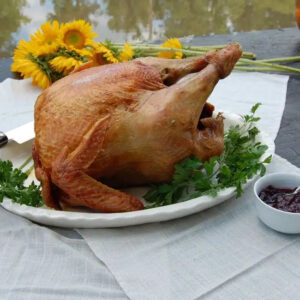
The fried turkey is the classic. While a turkey takes several hours in the oven, in the deep fryer it is often ready in well under an hour - with skin that is crispier than any other method and meat that remains juicy on the inside. The rule of thumb for cooking time is around three to four minutes per pound of weight, i.e. around seven to nine minutes per kilogram. A medium-sized turkey can be on the table surprisingly quickly. It is important that you choose a model with a sufficiently large pot, because the bird must be completely covered in oil.
Fish and shellfish
A classic American „fish fry" - fried fish in batter, often catfish, cod or perch - can be done in large quantities at the same time in the outdoor deep fryer. Shrimp, oysters and other crustaceans are also great for frying. Because the temperature remains stable, you can fry batch after batch without deteriorating quality. There is hardly a better way to enjoy a convivial fish dinner in the garden.
Fries, sides and donuts
Homemade French fries on a large scale, onion rings, chicken pieces, fried pickles or stuffed jalapeños - the outdoor deep fryer makes all of this in quantities that can fill a party. And if you like it sweet, you can deep-fry fresh donuts or doughnuts. The strength of the stable temperature is particularly evident when it comes to pastries: the pastries rise evenly and remain fluffy on the inside.
Low-country boil and boiling instead of frying
Thanks to the powerful burner, many outdoor deep fryers can also be used as a cooking area for large pots. The classic from the American South is the low-country boil: a huge pot with water, spices, shrimp, corn, potatoes and sausage is boiled together and then dumped on a large table. The powerful burner performance is also suitable for preserving, for large quantities of soup or for blanching. This makes your fryer a real all-rounder for the outdoor kitchen - a perfect complement to yours Grills & smokers.
An outdoor deep fryer is not a kitchen appliance that happens to be in the garden. It is an independent cooking tool for big moments - the banquet, the garden party, the fish evening with friends. Anyone who masters it has an ace up their sleeve that no oven or grill can replace.
The structure of an outdoor deep fryer in detail
In order to use the device safely and effectively, you should know its components. A good outdoor deep fryer essentially consists of four elements that must work together perfectly.
The burner
The heart of the matter is the gas burner. It is connected to a propane gas bottle via a pressure regulator and generates the enormous heat that heats the oil so quickly. High-quality burners are made of cast iron, are durable and easy to control. You control the flame and thus the temperature using a valve. A stable position of the burner is crucial because the entire construction must safely support the weight of the pot, oil and food to be fried.
The deep frying pot
The pot is ideally made of stainless steel, less often aluminum. Stainless steel is more robust, does not rust and is easier to clean. The volume determines what you can fry - you need significantly more capacity for a whole turkey than for fries. Many pots have a fill level mark or at least a clear indication of the maximum amount of oil that can be filled.
Basket, holder and accessories
For fries and small-sized fried foods, a frying basket is included, with which you can insert and remove the food at the same time. There are special poultry holders for the turkey with a hook and a lifting device, the so-called „lifting hook". This allows the heavy bird to be lowered into the oil and taken out again in a controlled manner and without splashing - a central safety element.
thermometer
Nothing works without precise temperature control. Many deep fryers have a built-in thermometer on the pot that you can use to read the oil temperature. We also recommend a separate meat thermometer to check the core temperature of the turkey or chicken. This is the only way you know for sure whether your fried food is cooked through.
The right frying oil: smoke point is crucial
The choice of oil is more important than many people think when frying outdoors. Since you're working with very high temperatures, you need an oil with a high smoke point - the temperature at which the oil begins to smoke and break down. If you exceed the smoke point, not only unpleasant odors and bitter substances arise, but also substances that are harmful to health. In addition, when oil smokes, the risk of a grease fire increases.
It is usually fried at around 175 to 190 degrees Celsius. Your oil should therefore have a smoke point well above it in order to provide upward reserves. The following table gives you an idea of common oils and their approximate smoke points. The values can vary depending on the degree of refining - refined oils usually have significantly higher smoke points than native, cold-pressed ones.
| Oil/fat | Approximate smoke point | Suitability for deep-frying |
|---|---|---|
| Refined peanut oil | approx. 230 °C | Very good – the classic for turkey, neutral in taste |
| Refined rapeseed oil | approx. 220 °C | Very good – cheap, neutral, widely available |
| Refined sunflower oil | approx. 225 °C | Very good – neutral taste, high heat resistance |
| Soybean oil | approx. 230 °C | Very good – stable and inexpensive for large quantities |
| Vegetable fat / frying fat | approx. 220 °C | Good – becomes solid when cooled and stores well |
| Extra virgin olive oil | approx. 160-190°C | Unsuitable – smoke point too low, too expensive |
| butter | approx. 150 °C | Unsuitable – burns too quickly |
When deep-frying a whole turkey, refined peanut oil is traditionally the first choice because it is tasteless, has a very high smoke point, and can be used multiple times. However, keep in mind that peanut oil can be problematic for people with nut allergies - if in doubt, ask your guests. Rapeseed oil is an excellent, inexpensive and lower-allergen alternative.
Temperature control: The art of the right heat
The perfect crust comes from the right temperature. Too cold and the food being fried becomes full of fat. Too hot and the outside will burn while the inside will remain raw. That's why a reliable thermometer is your most important tool. Heat the oil slowly and in a controlled manner and only insert the food to be fried when the target temperature has been reached.
A key point: If you put cold food to be fried in the oil, the temperature will initially drop. The more you put in at once, the greater the drop. That's why you should never fry too much at once and let the temperature come back up between batches. The following table gives you guidelines for different dishes.
| Court | Oil temperature | Approximate cooking time |
|---|---|---|
| Whole turkey | approx. 175 °C | approx. 3-4 mins per pound (7-9 mins/kg) |
| Chicken pieces | approx. 170-175°C | approx. 12-15 minutes. |
| Fish fillet in batter | approx. 180 °C | approx. 4-6 minutes. |
| Shrimp | approx. 180 °C | approx. 2-3 minutes. |
| French fries (twice fried) | 1st gear 150 °C / 2nd gear 180 °C | Pre-cook approx. 5 minutes, finish approx. 2-3 minutes. |
| Onion rings | approx. 180 °C | approx. 2-4 minutes. |
| Donuts/doughnuts | approx. 175 °C | approx. 2-3 minutes per side |
A pro tip for fries: Fry them twice. In the first pass at a lower temperature, you cook the potato through on the inside without it browning on the outside. After a short cooling break, put them back into the oil at a higher temperature - now the crispy, golden brown crust is created. This process separates good fries from outstanding ones.
The golden rule: How to fry a turkey safely
Now comes the most important section of this entire guide. Frying a whole turkey is the most spectacular, but also the most dangerous thing you can do with an outdoor deep fryer. The vast majority of serious accidents can be traced back to a single mistake: an incompletely thawed or wet turkey.
The reason is simple physics. When water or ice comes into contact with oil that is well over 100 degrees hot, the water suddenly evaporates. It expands many times over and explosively throws the boiling hot oil out of the pot. If this oil hits the gas flame, a huge flame is created. This is exactly how the infamous turkey fires start.
A second, equally important point is the correct amount of oil. If you add too much oil, the pot will overflow as soon as you put the turkey in - because the bird displaces volume. That's why there's a tried and tested trick to determine the right amount:
- Place the raw, still-wrapped turkey in the empty pot.
- Add enough water to just cover the turkey.
- Lift the turkey out and mark the water level.
- Pour away the water and dry the pot completely - not a drop of water should remain.
- Later fill in oil exactly up to this mark.
This will ensure that the oil does not overflow. Also, always lower the turkey into the oil slowly with the flame off or turned down. Only when the bird is safely in the pot and the initial heaving has passed do you turn the flame back up. This significantly reduces the risk of a flash fire.
Plan quantities and oil requirements correctly
How much oil you need depends on the size of the pot and the food being fried. For a whole turkey, you often need between 10 and 20 liters of oil, depending on the size of the bird and the pot. That's a significant amount - and a cost that you should plan for. The good news: With proper care, high-quality frying oil can be used multiple times, often for multiple frying sessions.
For smaller fried foods such as fries, fish or donuts, you need less oil because the pot doesn't have to be filled as high. The rule of thumb applies here: enough oil so that the food to be fried can float well covered, but always at a sufficient distance from the edge of the pot. As a guide, you should leave at least a hand's width of space between the oil level and the edge of the pot so that the oil can bubble up when inserting without overflowing.
Also plan the heating time. Despite the powerful burner, large amounts of oil take time to come up to temperature - expect a good half hour until the oil is ready for frying. So start early so your guests don't have to wait.
Safety: The rules that save lives
We can't emphasize it enough: an outdoor deep fryer is a powerful piece of equipment that demands respect. If you follow the following rules, you will fry for years without incident. Anyone who ignores them risks serious burns and fires.
Never use water on a grease fire
This is the most important rule of all. If the oil catches fire despite all caution, never try to put out the fire with water. Water on burning fat causes a huge explosion of fat, which suddenly increases the size of the fire and creates meter-high flames. Instead, smother a small grease fire by turning off the gas and covering the pot with an appropriate lid or fire blanket. In the event of an emergency, a suitable fire extinguisher for grease fires (fire class F) should be within reach. In the event of a major fire, get yourself and everyone else to safety and call the fire department.
The right location
Always place the deep fryer outdoors - never in a garage, under a carport, on a balcony with a roof, on a wooden deck next to the house or near flammable materials. The surface must be flat, firm and non-flammable so that the device is absolutely stable and cannot tip over. Stay clear of walls, fences, overhanging branches, and anything that could catch fire.
Distance, supervision and equipment
- Never leave the deep fryer unattended while it is in use – not for a single moment.
- Keep children and pets at a safe distance. If necessary, mark an exclusion zone.
- Wear heat-resistant gloves, long-sleeved clothing made from natural fibers, and closed shoes.
- Use safety glasses – splashing oil can seriously injure your eyes.
- Never overfill the pot. Too much oil is the most common cause of overcooking.
- Before each use, check the gas hose and connections for leaks and damage.
- After frying, allow the oil to cool completely before moving or discarding it.
Cleaning, oil care and disposal
After frying, the care begins - and this determines how long you can enjoy your deep fryer and how often you can reuse the oil. Never start cleaning while the oil is still warm. Wait until it cools completely. This may take several hours, so plan accordingly.
Filter and store oil
High-quality frying oil is too good to throw away after just one use. When the oil has cooled, pour it through a fine sieve or strainer cloth to remove any breading and food residue. These residues would otherwise burn the next time you heat it and lower the smoke point. Store the filtered oil in a dark, cool place and tightly closed. This way you can reuse it for multiple sessions. The next time you use it, look out for signs that the oil is used up: it becomes dark and viscous, foams heavily, smells rancid or smokes even at lower temperatures. Then it's time for fresh oil.
Dispose of oil correctly
Old frying oil should never be put down the drain or toilet - it clogs the pipes and pollutes the sewage system. Instead, pour the cooled oil back into the original bottles or lockable containers and hand it in at the recycling center or pollutant collection point. Small amounts of solid fat residue can be disposed of with residual waste. Find out about the rules in your community - in many places there are special collection points for used cooking oil.
Clean pot and burner
After emptying, clean the stainless steel pot with warm water and dishwashing liquid. Stubborn residue can be removed with a non-scratching sponge. Then dry the pot very thoroughly - every drop of water is a risk the next time you fry. Keep the burner free of grease splashes and regularly check whether the gas openings are clear. Store the entire device dry and protected from the weather, ideally under a suitable cover, which you can find in our Grill accessories find.
Buying criteria: What you should pay attention to when buying
A good outdoor deep fryer is a purchase that will last for many years. To find the right one for your needs, you should pay attention to the following criteria.
Power in BTUs
The heating output of gas burners is often given in BTUs (British Thermal Units). The higher the value, the faster the oil heats up and the better it maintains the temperature under load. High performance is an advantage for large quantities and whole turkeys. But also pay attention to good controllability - a burner that can be finely dosed gives you more control over the temperature.
Material and workmanship
Stainless steel is clearly preferable for pots and supporting parts. It is durable, rust-resistant and hygienic. Cast iron burners are robust and can withstand high temperatures. Pay attention to clean workmanship, stable weld seams and a stable frame. Cheap designs with wobbly legs pose a real safety risk when handling gallons of hot oil.
capacity
Think about what you mainly want to fry. For whole turkeys you need a large pot with the appropriate volume. If your main concern is fish, chips and side dishes, a smaller model is sufficient. Remember that a larger pot also requires more oil and more energy to heat up.
Safety equipment and accessories
Good models have well-thought-out safety features: a reliable thermometer, a sturdy stand, high-quality gas regulators and lifting devices for the turkey. Check which accessories are included and what you may need separately.
| criterion | What to pay attention to | Why it matters |
|---|---|---|
| Burner output (BTU) | High and finely adjustable | Fast heating, stable temperature under load |
| Pot material | Prefer stainless steel | Durable, rustproof, easy to clean |
| capacity | Suitable for the fried food | Whole turkey needs more volume than fries |
| Stability | Wide, stable frame | Prevents dangerous tipping over |
| thermometer | Easy to read, precise | Temperature control is key |
| lifting device | Hook and holder included | Safe lowering and lowering of the turkey |
Useful accessories for your outdoor deep fryer
With the right accessories, deep-frying becomes safer and more comfortable. You should get these helpers:
- Frying thermometer: A separate, easy-to-read thermometer for the oil temperature if a reliable one is not installed.
- Meat thermometer: For checking the core temperature of turkey and chicken - essential for safely cooked poultry.
- Poultry farmer with lifting hook: For controlled lowering and lowering of the turkey.
- Heat-resistant gloves: Long grill gloves protect hands and forearms.
- Slotted spoon and long tongs: For turning and removing smaller fried foods at a distance.
- Oil filter and storage container: For filtering and storing the reusable oil.
- Grease fire extinguisher (Class F) and fire blanket: The most important safety accessory of all.
- Cover: Protects the device from the weather between uses.
You can find many of these helpers and more in our range Grill accessories. If you want to further expand your outdoor kitchen around the deep fryer, it's also worth taking a look at ours Outdoor grills – together they create a complete cooking landscape for every occasion.
Recipe ideas and inspiration
So that you can get started right away, here are a few ideas that will shine in the outdoor deep fryer.
The classic fried turkey
The thawed, dry turkey is seasoned before frying - often with a dry marinade (rub) made of salt, paprika, garlic and herbs, sometimes with an injected marinade (injection) for seasoning to the core. Important: Injected marinades should not be too liquid and the bird must be patted dry after marinating. Deep-fried at around 175 degrees, it becomes crispy in a short time - always check the core temperature with a meat thermometer.
Southern fish fry
Fry fish fillets in a breading made from cornmeal and spices, served with coleslaw and fried green tomatoes. A sociable meal that works in large quantities and is guaranteed to create enthusiasm at garden parties.
Double fried fries
Cut fresh potatoes into sticks, water, dry and fry using the two-step process described above. The result is fries that are crispy on the outside and fluffy on the inside - far better than any frozen product.
Low country boil
For a change without oil: Cook shrimp, corn, small potatoes and spicy sausage together in seasoned water, drain and serve on a large table. A sociable dish that makes perfect use of your deep fryer's versatile burner capacity.
Why you should buy your outdoor deep fryer from us
At grillundsmoker.de everything revolves around outdoor cooking at the highest level. We carry selected, high-quality outdoor deep fryers that we ourselves consider to be recommended - robustly manufactured, safely constructed and made for real use. Instead of a confusing mass range, we focus on quality that lasts for years.
What sets us apart is advice. An outdoor deep fryer is a purchase that depends on making the right choice - from the right capacity to the safety features. Our team knows the devices from their own experience and will be happy to help you find the right model for your projects. Whether you want to fry a turkey once a year or organize large fish sessions on a regular basis, we will find the right solution together.
There is also a well thought-out range of accessories with which you can operate your device safely and comfortably, as well as the option of setting up your entire outdoor kitchen from a single source. From the smoker to the grill to the deep fryer – with us you get coordinated quality and honest advice. If you have any questions, just contact us. We look forward to helping you achieve your perfect frying experience.